Cosme's False Testimony for Alicia
Los renglones torcidos de DiosCosme's False Testimony for Alicia is the account of how Cosme el Hortelano invented an eyewitness version of a patient's death to protect Alice Gould from lasting legal and institutional consequences. The lie was not simply his own intervention: the director authorized a revised account for court and agreed to rely on that witness alone, turning Cosme's fiction into the version accepted for the case. Its protective effect is shadowed by Alice's knowledge that Cosme had not seen the death at all.
The Death and the Official Account
The account Montserrat Castell gives Alice begins with the director's decision. He considered himself not responsible for what had happened, but did not think it fair for Alice to carry forever a record of having killed a man, even if his death had been accidental. He therefore authorized the witness to give another version before the court and committed himself to accepting what that single witness said. The arrangement put the director's authority behind a story that would shield Alice from the consequences of the earlier account.
The revised version described the hunchbacked man as someone who habitually ran wildly and without direction. According to the testimony, on this occasion he stumbled, struck a rock, and broke his spine. The death was presented as having occurred without anyone's intervention. The explanation shifted the event from a death for which Alice might be blamed to an accident caused by the man's own fall. It did not merely soften her responsibility: it denied that another person had taken part in the fatal event.
Cosme's Role and Motive
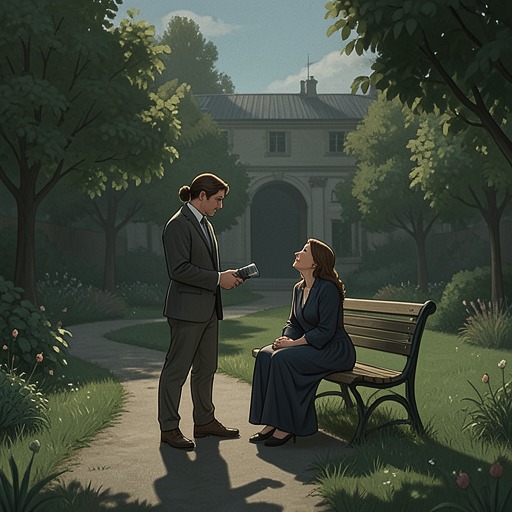
The witness was Cosme, whom Montserrat identifies by his familiar designation, Cosme el Hortelano. Alice's immediate question about who had testified gives way to recognition: she blushes because she understands that the old man could not have witnessed what he described. Alice herself had told him what happened. The testimony's claim to eyewitness authority was therefore a fabrication, not a mistaken recollection.
Cosme chose to make that fabrication because he believed Alice was telling the truth and wanted to spare her the distress of being accused. He feared that people might say she had practiced judo on disabled and physically deformed patients out of whim or madness. His lie addressed both the danger of a legal accusation and the humiliating interpretation that might be attached to her conduct. To the doctors, he said he had seen what he had not seen; to the court, he gave an account of events that had not occurred. The two audiences received versions serving the same protective purpose.
In a later conversation with Heliodoro Almenara, Cosme repeats the accidental-fall account in his own plain-spoken manner: the man ran like a startled hare, tripped, struck a rock, and broke his hunchback. He tells Heliodoro not to keep thinking about the matter and turns back to his appointment with the carrots. The casual ending sits beside the grave consequence of the story: Cosme treats the matter as settled, while his testimony has helped determine how the death will be understood.
Alice's Knowledge and the Story's Tension
Alice is relieved to learn that the account has allowed her to come through the predicament, and Montserrat makes clear that the director, as well as Cosme, deserves some of the credit. But Alice does not mistake protection for truth. She recognizes that Cosme's testimony is false precisely because he learned the real events from her, and she keeps that realization to herself, not voicing it even to Montserrat. Her silence preserves the benefit of the lie while marking the distance between the story accepted by the court and what she knows happened.
The episode thus rests on a reversal of ordinary testimony: the supposed witness's authority comes not from having seen the death but from Alice's confidence in him, while the director's approval lends the invented account institutional force. Cosme's intervention may spare Alice a permanent record, but it does so by replacing the event with a version that absolves everyone of direct involvement. His good intention and the falsity of his evidence remain bound together; the protection is real, but so is the concealed truth on which it depends.